
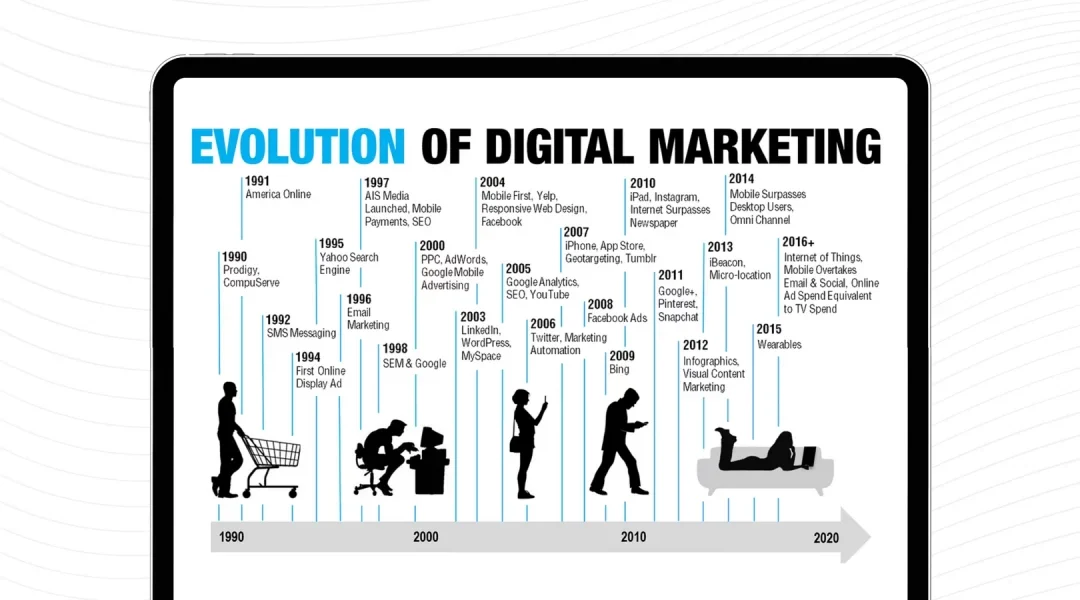
Are looking for the History of Digital marketing, it feels like a modern invention, but its roots stretch back .
Digital Marketing helps us to understand about its importance in business further than most people realise. What started as a single unsolicited email in 1978 has grown into a trillion-dollar industry shaped by search engines, social platforms, mobile phones, and now artificial intelligence. Understanding this evolution isn’t just a history lesson, rather it helps businesses in Singapore and beyond spot where marketing is headed next, and adapt before competitors do.
https://pavaniscinde.comBest AI Digital Marketer in Singapore!
Contents
The Spark in History of Digital Marketing: 1970s–1980s
Digital marketing’s earliest ancestor arrived in 1978, when a marketer at Digital Equipment Corporation sent a promotional message to roughly 400 people on ARPANET, the precursor to the internet. It was clunky and unsolicited, but it generated millions of dollars in sales, proving that reaching people directly through a screen could work. Around the same time, businesses began experimenting with early databases to track customer information, laying the groundwork for what would later become customer relationship management (CRM) systems.
The Birth of the Web: 1990s
The 1990s changed everything. In the History of Digital Marketing, the first clickable banner ad appeared in 1994 on the website HotWired, and it reportedly earned a 44% click-through rate , a number modern marketers can only dream of today. That same decade saw the launch of search engines like Yahoo and, eventually, Google in 1998, which introduced a completely new way for businesses to be discovered: not through interruption, but through relevance. As years passed by the web crawled all over the world making things easy and efficient.
Email marketing also matured during this period. Businesses realized they could build direct relationships with customers by sending newsletters, promotions, and updates straight to an inbox, without paying for print or postage. This decade essentially created the two pillars digital marketing still stands on: paid advertising and organic discovery.
The Search and Social Boom: 2000s
The 2000s brought structure to the History of Digital Marketing. Google introduced AdWords (now Google Ads) in 2000, giving businesses a way to pay for visibility based on what people were actively searching for. Search engine optimization (SEO) became a discipline of its own, as marketers learned to earn visibility instead of just buying it.
Then came social media. Platforms like Facebook (2004), YouTube (2005), and Twitter (2006) shifted marketing from a one-way broadcast to a two-way conversation. For the first time, brands could see, in real time, how audiences reacted, shared, and talked about them. This decade also saw the rise of content marketing as businesses realized that blogs, videos, and guides could attract customers without directly selling to them.
Mobile and Influence: 2010s
The launch of the iPhone in 2007 didn’t just change consumer behaviour in the History Of Digital Marketing, it rewired how marketing had to work. By the early 2010s, more people were browsing on phones than desktops, forcing marketers to rethink website design, ad formats, and even how long content needed to be to hold attention.
This decade also introduced influencer marketing as platforms like Instagram (2010) turned everyday users into micro-celebrities with engaged, trusting audiences. Meanwhile, marketing automation tools like HubSpot and Marketo matured, allowing businesses to nurture leads with personalized email sequences instead of one-size-fits-all blasts. Data became a competitive advantage: the more a business understood its customers, the more precisely it could target them.
The Data-Driven Era: Mid-2010s to 2020
In the History of Digital Marketing, crucial phase enfolds! As platforms collected more user data, marketing became increasingly programmatic, meaning ad space could be bought and sold automatically through algorithms in real time, based on who was most likely to convert. Personalization moved from “nice to have” to expected; customers grew used to seeing product recommendations and retargeted ads that felt tailored to them specifically.
This period also brought growing scrutiny. Data privacy regulations like the EU’s GDPR (2018) forced businesses to be more transparent about how they collected and used customer information, signalling that the free-for-all data collection of the early 2010s was coming to an end.
The AI Revolution: 2020–Present
The most recent shift has been the fastest in the History of Digital Marketing. The COVID-19 pandemic accelerated e-commerce and digital adoption by years in a matter of months, pushing even traditionally offline businesses to build a digital presence. Then generative AI tools, including large language models and AI-powered ad platforms that began reshaping how marketing content gets created, tested, and optimised. Key changes include predictive analytics, deep personalisation, and automated content creation.
Today, AI assists with everything from writing ad copy and analysing customer sentiment to predicting which audiences are most likely to convert before a campaign even launches. Digital marketing used simple tools to schedule social media posts and send mass emails. Over time, machine learning introduced predictive analytics that study user habits in real time. Instead of guessing what buyers want, systems now look at past actions to guess future choices. Marketers are no longer just publishing content; they’re using AI to research faster, personalise more precisely, and make decisions backed by predictive data rather than guesswork. For small and medium businesses especially, this has levelled the playing field in AI tools that once required a large in-house team are now accessible to a single skilled freelancer.
What’s Next: Where History of Digital Marketing Is Headed
Looking ahead, a few shifts are already underway:
- AI-generated and AI-assisted content will continue to speed up production, but businesses that combine AI efficiency with genuine human insight will stand out.
- Voice and conversational search are changing how content needs to be structured, favoring clear, direct answers over keyword-stuffed pages.
- Privacy-first marketing will keep growing as third-party cookies phase out, pushing businesses toward first-party data and direct customer relationships.
- Hyper-personalisation powered by AI will make generic, mass-market campaigns feel increasingly outdated.
Why This History of Digital Marketing Matters for Your Business
Every shift in History of Digital Marketing rewarded businesses that adapted early and penalised those that waited. The move from banner ads to search, from search to social, and from social to AI-driven personalization all followed the same pattern: early adopters gained a visibility advantage that was hard for latecomers to catch up on.
That’s exactly the position AI marketing occupies today. Businesses that start integrating AI-driven strategy now : smarter targeting, faster content production, more precise personalisation, are positioning themselves the way early search and social adopters once did. For Singapore SMEs and startups looking to grow without the overhead of a large in-house team or agency, working with a freelancer who understands both marketing fundamentals and AI tools offers a practical way to stay ahead of this next shift, rather than trying to catch up on it later.
Website: https://digitalscholar.in
Hoping that this History of Digital Marketing gives a clear picture to business owners on the importance of using it than traditional marketing. This article is contributed by PS!About
Before starting a business and wondering how to run it …this history helps owners to have good understanding of technology to incorporate into business!